

How can vocational education become more accessible to migrant women while responding to Europe’s growing need for skilled professionals in the care sector?
This is one of the central questions addressed by CARE-ABILITY, an Erasmus+ project working to create more inclusive and flexible pathways into social and healthcare professions for migrant women.
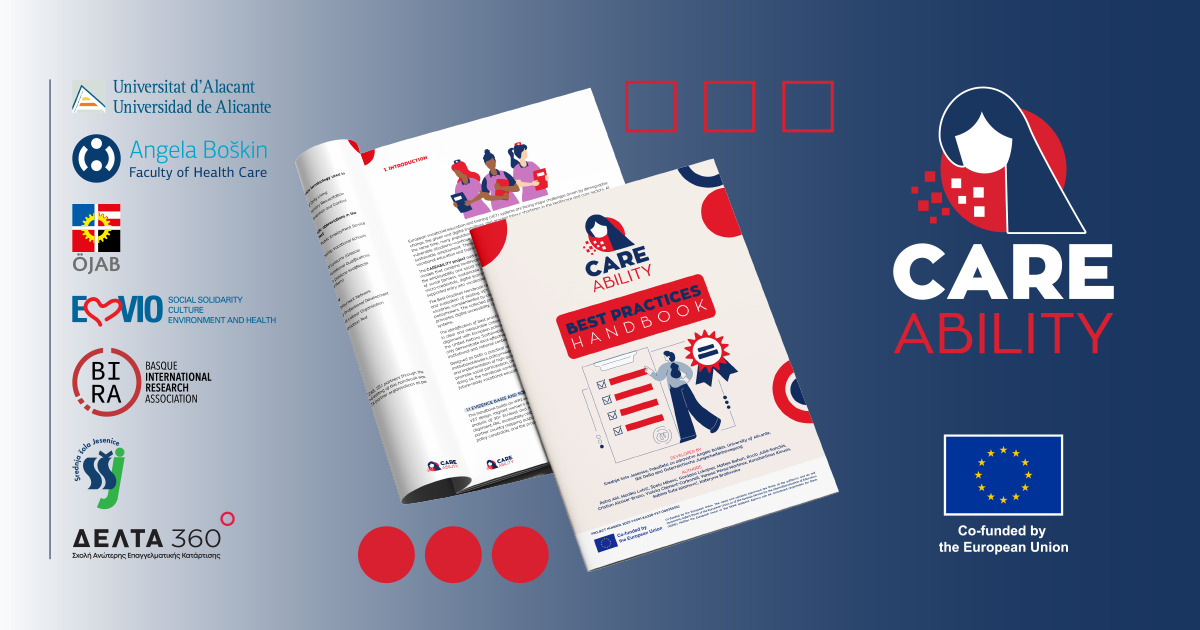
Over the past months, the project has reached an important stage in this work. The publication of the CARE-ABILITY Best Practices Handbook has been accompanied by a series of workshops across Europe, bringing the project’s research and recommendations into direct dialogue with educators, professionals, institutions and other stakeholders.
Turning evidence into practical guidance
The Best Practices Handbook provides a practical and strategic resource for VET educators, training providers, institutional leaders, policymakers and professionals working in the care sector. It draws on extensive research and cross-country mapping carried out in Austria, Greece, Slovenia and Spain, examining existing vocational training approaches, policy frameworks, inclusion mechanisms and examples with potential for transfer to other European contexts.
Rather than simply collecting successful initiatives, the Handbook identifies the elements that make inclusive pathways work in practice. These include flexible and modular training, language support integrated into vocational learning, recognition of prior learning, mentoring and peer networks, accessible learning environments and closer cooperation between VET providers, employers and social services.
Particular attention is given to the realities migrant women may face when entering education or employment: language barriers, care responsibilities, financial constraints, limited recognition of previous qualifications or professional experience, and unfamiliarity with national education and employment systems.
The Handbook therefore goes beyond educational content. Its recommendations address the wider conditions needed to make participation, qualification and progression realistically accessible.
Bringing stakeholders into the conversation
The next step was to take these findings outside the project partnership.
Between April and June 2026, CARE-ABILITY partners organised workshops in Slovenia, Greece, Spain and Austria, engaging more than 140 participants overall. The events brought together VET educators and trainers, healthcare and care-sector professionals, employment specialists, NGOs, public authorities, researchers, educational institutions and women with a migration background.
These workshops were not designed simply to present project results. They created spaces for discussion around the practical implementation of inclusive vocational pathways.
In Greece, participants explored the role of micro-credentials, accessible training and innovative learning methods in supporting migrant women entering the socio-healthcare sector. In Spain, stakeholders discussed the Handbook and the potential for cooperation around inclusive VET and labour-market integration. In Slovenia, several workshops brought together education, healthcare, employment and social inclusion actors, generating feedback on language barriers, mobility, participation incentives and the adaptability of training pathways. In Austria, the discussion focused particularly on moving from experience to recognised qualification, including the importance of language support, accessible training and clearer connections between learning and employment.
From consultation to the next stage of CARE-ABILITY
The discussions confirm an important principle behind CARE-ABILITY: inclusive training cannot be developed effectively without involving the people and organisations that will eventually use, support or implement it.
The feedback gathered through these workshops contributes to the continuing development of the project’s learning approach, including its planned 50-hour micro-credential programme, which aims to provide migrant women with a flexible entry point into the care sector while supporting the recognition and further development of their competences.
The Best Practices Handbook and the workshop results represent more than two individual project activities. Together, they illustrate the approach CARE-ABILITY is pursuing throughout its implementation: researching what works, listening to those working in the field, and translating both into practical and accessible learning solutions.
