

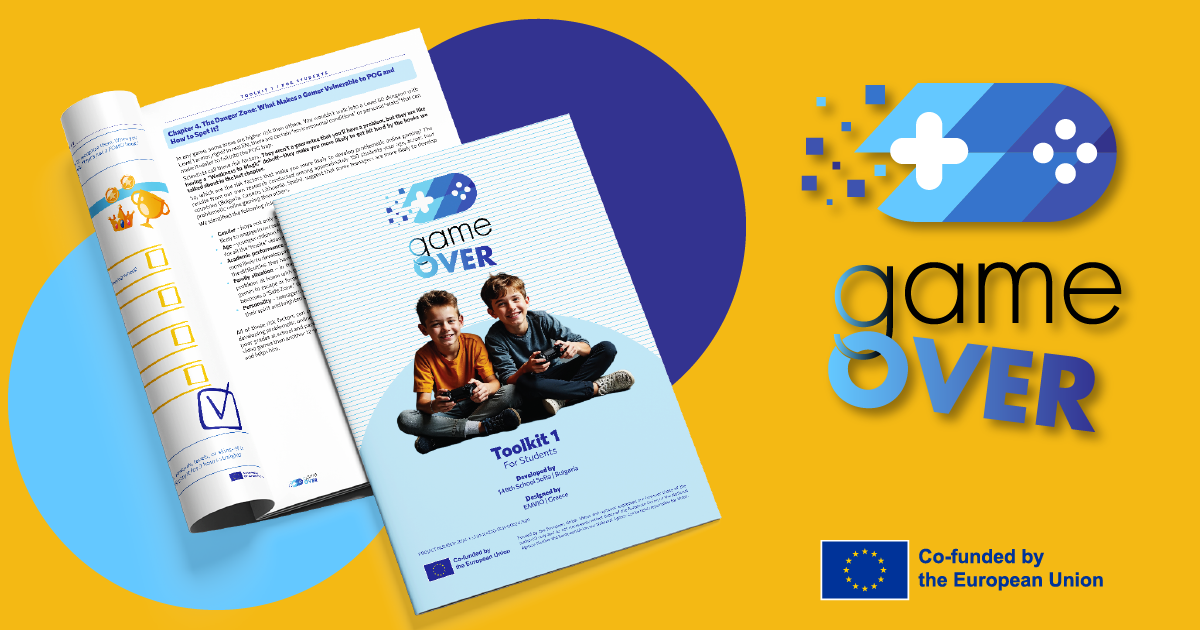
Online gaming is now part of young people’s everyday lives. It is entertainment, communication, creativity, cooperation and often a way to relax after a difficult day.
But there is another side. What happens when “one more game” turns into three hours? When sleep is reduced, schoolwork falls behind, or offline friends slowly start to disappear from the picture?
The GameOver Toolkit for Students was created to speak directly to students in a clear, simple way that feels close to their own language. It does not lecture them. It does not present gaming as the enemy. Instead, it helps them understand when gaming remains a healthy habit and when it starts to affect real life.
The toolkit uses smart gaming references, such as “mini-quests”, “danger zone”, “balance build” and “self-scan”. Through these, students can recognise signs of excessive use, think about why they play, identify what keeps them inside the game and find ways to take back control.
One of the most interesting parts of the toolkit is that it explains how some games are designed to keep players online. Daily rewards, limited-time offers, loot boxes, streaks and countdowns are not random. They are mechanisms that create pressure, habit and fear that something will be lost if the player disconnects.
The toolkit also offers practical solutions. It suggests breaks, limits, better sleep habits, offline activities and simple self-reflection exercises. Students are invited to observe how they feel before and after gaming, why they start playing and when they find it difficult to stop.
This is where the real value of the material lies: it is not about banning gaming. It is about awareness. Choice. Balance.
The GameOver Toolkit for Students can be used by students, teachers, school counsellors and psychologists as a tool for discussion, prevention and empowerment. It helps young people look at gaming more clearly and keep what really matters: the joy of playing, without losing touch with real life.
Because the point is not for students to stop playing.
The point is to learn when to press Save & Exit.
Explore the Toolkit for Students here: https://gameover-project.eu/wp-content/uploads/2026/03/EN_toolkit_STUDENTS.pdf
